- BDU IR Home
- →
- School of Law
- →
- Law
- →
- Thesis
- →
- View Item
JavaScript is disabled for your browser. Some features of this site may not work without it.
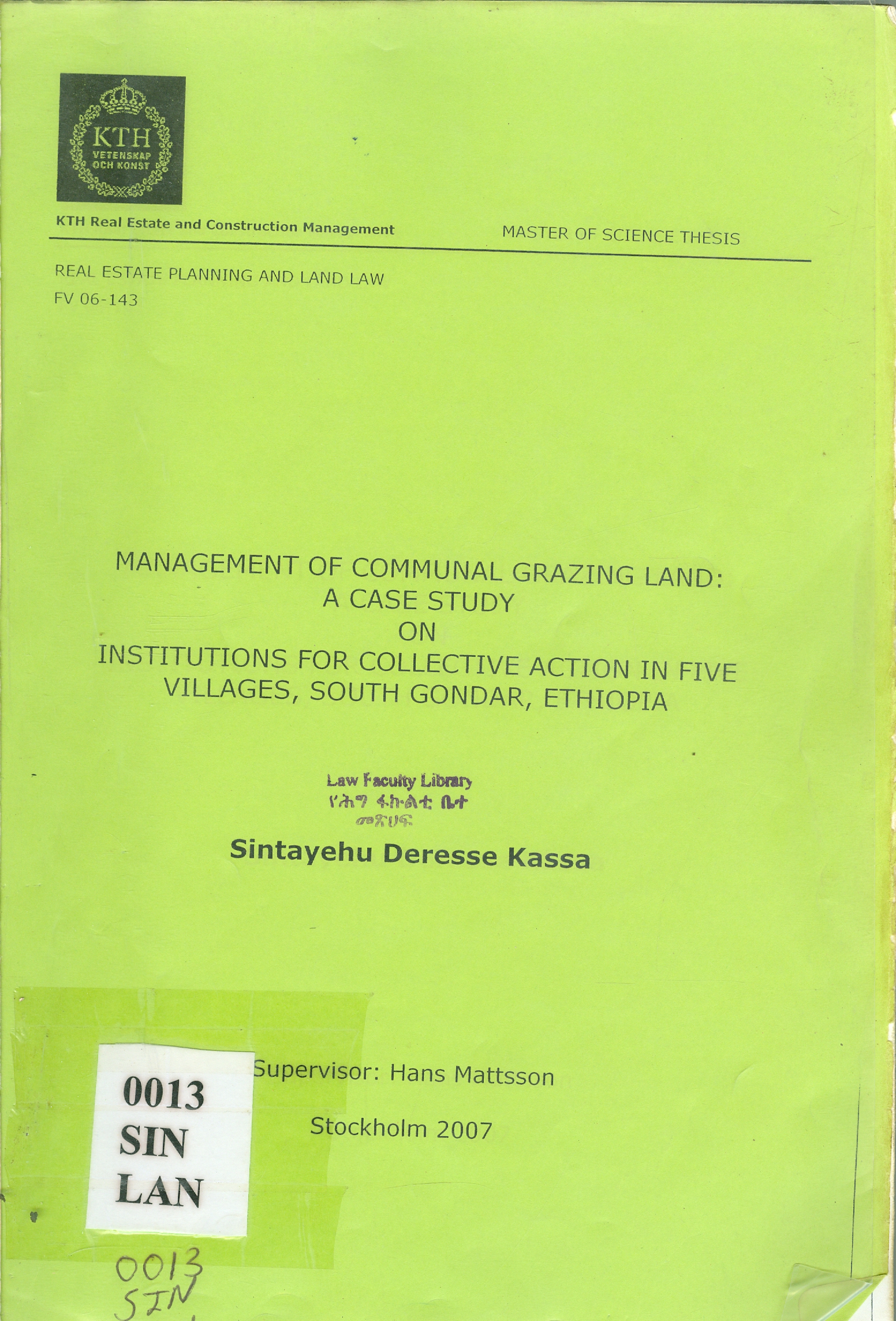
Management of Communal Grazing Land: A Case Study on Institutions for Collective Action in Five Villages, South Gondar, Ethiopia
Sintayehu, Deresse
Date:
2018-01-03
Abstract:
This study was conducted Lo assess and evaluate in,1it11rional performance in the study
vii luge; with regard IU communal gnit:ing land and produce eight justif.ablc answers 10
Osumn's design principles and to check whether the common land users arc willing 10 form
robust institutions for the better management of communal grazing Ian~ and solve the
prob lcm of overuse of 1 hcse resources.
Accordingly. the important data were collected from the noth-sooth and cast-west transect
walks, fror1 a survey of' randomly selected common land rscrs, Irorn interviews with key
informants, discussions with rM~. KLAUl'. KA and Kebele Social C'ou11, from
questionnaires given to El'LA\JT and CPL\UA, from personal communications with some
important Individuals and finally from the feedback meeting The generated dnta were
presented i·1 tables and percentages. The result of all the collected data were then analyzed
based both on quantitative and qualitative methods in a way that can achieve the objective
ofihc.srudy.
I'hc grazing land during the Derg regime was demarcated as a communal grazing land;
however. however, the substantial portion of' the gra1ing land was given tu Peasant
producers' Cooperative Association is subdivided to be used ror culrivation. After the
downfall cf the Derg regime, the area which was given 10 the Peasant producers'
Cooperative Association was orought back to a communal grll7..ing land. However. as rime
went on. tl.e size of the communal grazing land has become reduced due to a m.rnber of
reasons mainly encroachment and frequent land redistribution causing grazing lands to be
changed to crop lands. Moreover, the ever-increasing human population is the root cause
lilr rhe .overuse of the grazing land. Hy recognizing the s.tuarion, the people concluded
verbal agreement to subdivide part of the communal grazing land as oxen gra7.ing area. The
traditional institution (oxen grass committee) after establishcd , by the users have
succ<i'Ssf'ully protected access each for a period of seven months and half to reduce overuse
of the grazing land. Moreover, the people appoint one guard for better protection of the
oxen grazing area.
Besides, some eight years ago the people further agreed to subdivide the res'. of the
communal grazing land into permanent mid seasonal-all-livestock grazing areas. The
seasonal-all-livestock grazing area is allotted for nil types of livestock; however, access is
allowed only for four and half months of' each year. Two guards are appointed for the
scasonal-all-Iivesrock grazing area. However. the agreement has not yet considered a wry
important issue regarding the restriction i11 the quantity of resource 11:1it robe extracted from
the oxen and seasonal-al l-livesrnck grazing areas. The permanent grazing area is in u state
of open access. Nobody includ:11,; nun-members is prohibited from using (he grazing area at
any time with unlimited number of livestock. Currently some individuals from the neighbor
kehd~ are usinj! the grazing land. As a result, even at the potential season of the year (end
of rainy season) the grazi n g land is extremely overused.
Due to differences in the management measures between the oxen, seasonal-all-livestnck
and permanent grazing areas, there arc spatial ditforcnces in the grassland ecosystem. With
Files in this item
This item appears in the following Collection(s)
Search
Browse / Search
-
All of BDU IR
-
This Collection